









B.C. team’s ocean-hacking efforts shine silver
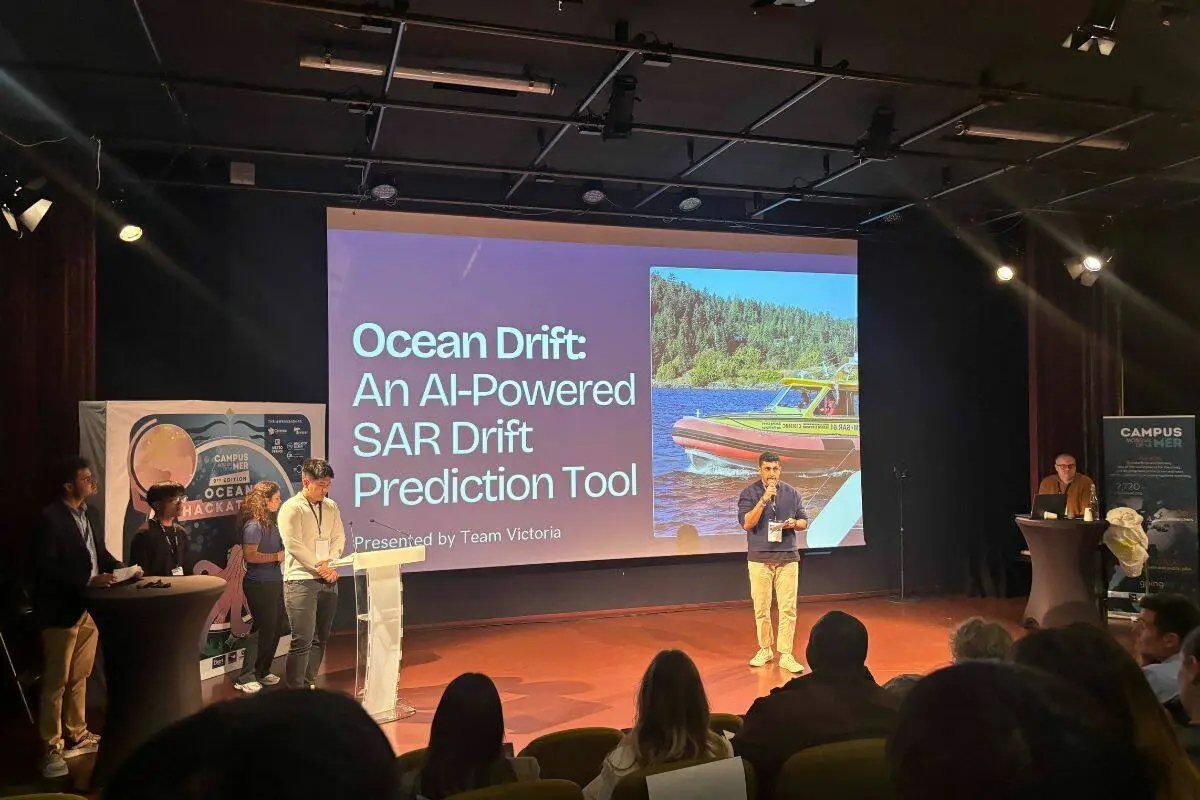
It was the first time B.C. joined the Ocean Hackathon, yet the B.C. team’s ocean-hacking efforts shine silver at global tech competition. Representing Victoria’s Centre for Ocean Applied Sustainable Technologies (COAST), the group finished second out of 57 teams at the Ocean Hackathon 9 Grand Finale in Brest, France.
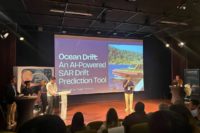
Their winning concept, called Ocean Drift, uses artificial intelligence and deep learning to model complex currents in the Strait of Georgia. The goal is to help search-and-rescue crews predict where people or vessels might drift and to narrow the search area more quickly.
Ocean Drift built in 48 hours
The five-member team first came together during a 48-hour Ocean Hackathon event hosted at the COAST Hub in Victoria. They met as students from UVic, UBC, Northern University and BCIT who all chose the same challenge proposed by Ocean Networks Canada.
Over that intense weekend, they built a working prototype from scratch. In the weeks before the finals, they refined their code and their pitch, but the core of Ocean Drift still came from that non-stop sprint.
From Victoria to the world stage
At the finale in Brest, the B.C. team’s ocean-hacking efforts shine silver at global tech competition as the only North American entry in the field. Their strong performance earned them second place and 3,000 euros in prize money.
COAST operations coordinator Camille Ruest says one of Ocean Drift’s strengths is its scalability. Anywhere reliable ocean data exists, the tool could be adapted to assist search-and-rescue teams and other marine operations.
Building an ocean innovation hub in B.C.
The Victoria event marked the first Ocean Hackathon ever held in British Columbia. COAST partnered with Ocean Networks Canada to bring the competition here, tying it directly to the province’s growing “blue economy” sector.
COAST executive director Jason Goldsworthy says the hackathon fits the organization’s mission to strengthen the Pacific region’s ocean innovation network. He believes competitions like this help early-stage teams experiment, test ideas and turn vast stores of ocean data into practical tools.
Pride in B.C.’s first showing
Beyond the podium finish, B.C. also had a voice on the international judging panel. Ruest, who helped produce the Victoria hackathon, joined the finale jury in Brest.
She calls it an honour both to host the first Ocean Hackathon in the province and to watch the B.C. team’s ocean-hacking efforts shine silver at global tech competition. For her and for COAST, the result shows how local talent can tackle global ocean challenges—and be noticed on the world stage.
Stay updated instantly — follow us on Instagram | Facebook | X












Leave a comment